Baldur's Gate 3 (stylized as Baldur's Gate III) is a 2023 role-playing video game by Larian Studios. It is the third installment in the Baldur's Gate series. The game's full release for Windows was in August, with PlayStation 5, macOS, and Xbox Series X/S later in the same year. In the game's narrative, the party seeks to cure themselves of a parasitic tadpole infecting their brain. It can be played alone or in a group.
Adapted from the fifth edition of tabletop role-playing game Dungeons & Dragons, Baldur's Gate 3 takes its mechanics and setting, the Forgotten Realms, from the tabletop game. Players create a highly customisable character and embark on quests with a party of voiced companions. Alternatively, they can play as a companion instead. The gameplay comprises real-time exploration of large areas, turn-based combat, and narrative choices which impact the party and the wider world. Outcomes for combat, dialogue and world interaction are generally determined by rolling a 20-sided die.
Baldur's Gate (1998) and Baldur's Gate II: Shadows of Amn (2000) were developed by BioWare. A third game, subtitled The Black Hound and developed by Black Isle, was cancelled in 2003 following a licensing dispute. Dungeons and Dragons owner Wizards of the Coast (WotC) declined Larian's first pitch to make the game following the release of Divinity: Original Sin (2014). Impressed by pre-release material for Divinity: Original Sin II (2017), WotC welcomed a new pitch and eventually greenlit Larian's development. The company grew considerably in the six-year production. In August 2020, Larian released the game's first act in early access, providing them with player feedback and revenue. After the full release, Larian added free new content to the game until the final patch in April 2025.
Baldur's Gate 3 has been regarded as one of the greatest video games of all time. It received universal critical acclaim and had record-breaking awards success, with praise directed at its cinematic visuals, writing, production quality, and performances. It became the first to win Game of the Year at all five major video game awards ceremonies and received the same honour from several publications. It also generated significant profit for both Larian Studios and WotC's parent company Hasbro.
Gameplay
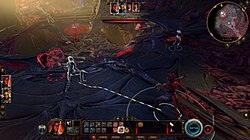
A screenshot of a combat scenario, showing the top-down isometric view
Baldur's Gate 3 is a role-playing game, and can be played in single-player or multiplayer. It has a free-floating camera, with players able to adjust the perspective from top-down isometric to third person. Based on the fifth edition rules of the tabletop game Dungeons & Dragons (D&D 5e), several mechanics are identical between the two. A major feature is that outcomes are decided by rolling a twenty-sided die (d20). Some rolls occur with "advantage" or "disadvantage", meaning two d20s are rolled and the player receives the best or worst result, respectively. The game includes support for modding, but using them disables achievements.
In character creation, the player selects a class, species, and backstory. If the selected class uses magic, they will also choose their starting spells. Characters level up by collecting experience points by several means—examples include exploration, combat, and solving puzzles. Levelling up provides access to new abilities. The maximum player level of Baldur's Gate 3 is level 12; in the tabletop game, the limit is level 20. Available at certain level intervals are feats. These diversify or specialise a character's style of play. With each feat, players choose a new ability or increase their stats, which are called attributes. After levelling up, players can also choose to place a level into a different class, known as multiclassing.
Quests and exploration
The game is divided into three narrative arcs, with a large, explorable location tied to each. In non-combat scenarios, it is primarily experienced in real time. There are 288 quests,: 1:23 with significant creative freedom as to how they are completed, some being mutually exclusive, and some unfolding across multiple arcs. Companions have their own side quests, but the game can be completed without companion presence. Almost any character can die, including those integral to the narrative, and all speaking characters are fully voiced. Using a spell or potion, players can speak to any encountered animal, and a more limited number of corpses.
Players can set up a camp as a way to rest from the adventure and talk with companions. There are 17 unique camp locations, contextually dependent on where in the game world the camp is set up. A non-player character based at camp, Withers, allows players to respec. Limited resources—for example, hit points and spell slots—are replenished by resting. There are two types of rest: long and short. A short rest restores 50% of the characters' maximum hit points alongside some class-specific features. Players can short rest twice before they must long rest to replenish them. Long rests teleport players back to camp and fully replenish resources.
Players select items in the world, such as chests, to interact with them. Items, like explosive barrels, can be sent to a camp stash and retrieved later. Picking locks, disarming traps, and exploring locations grant experience. If the player attempts to pick a lock, the game rolls a dice; the result is compared against the value required to open the lock. A character's skills or abilities can add to the rolled value, making it easier.
Combat
The game's combat systems are modelled on D&D 5e. Entering combat switches the to turn-based mode. A d20 roll, called an initiative roll, determines the order in which each character acts. In a turn, each character has limited resources. The primary resources are actions, bonus actions, and movement. Major instructions to a character, like attacking with a sword or casting a spell, consume an action. Smaller commands, like jumping or drinking a potion, consume a bonus action. Characters can also move a set distance. When a character has used all of their resources, the player ends the character's turn. Combat ends when all enemies are defeated. Outcomes are determined through hidden dice rolls.
When a character attacks, the game rolls a d20—this is called an attack roll. The result is compared against the target's armour class; if the roll value is lower than the armour class, the attack misses. Players can see the percentage-change that an attack will hit before making it; this value is impacted by things like terrain. Some attacks have damage types. These can amplify one another (e.g., applying grease and fire to a target will make them burn for multiple turns) or counteract the other's effect (e.g., firing a fire arrow at an enemy standing in ice). Environmental elements like explosive barrels can be exploited, and weapons can be dipped in poison.
Social
Conversations are another area of gameplay in Baldur's Gate 3. Some conversations include skill checks, wherein the player rolls a d20, with the result affecting the outcome. Players can initiate combat by selecting an aggressive dialogue option, or use dialogue to avoid combat entirely. This is a major feature of the charisma-focused bard class. Dialogue options can involve persuasion, intimidation, and deception.
Player characters can initiate romance or sexual relationships with many non-player characters. Actions and dialogue options affect relationship outcomes. Characters that can be romanced are "playersexual", meaning the player character's gender does not impact romance availability. The game has thirteen romance options.




















 USD USD
 EUR EUR
 GBP GBP
 CAD CAD
 AUD AUD