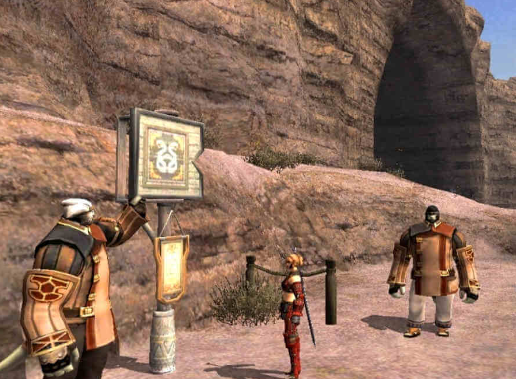
Final Fantasy XIV
Final Fantasy XIV is a massively multiplayer online role-playing game (MMORPG) developed and published by Square Enix. Directed and produced by Naoki Yoshida and released worldwide for PlayStation 3 and Windows in August 2013, it replaced the failed 2010 version, with subsequent support for PlayStation 4, macOS, PlayStation 5, and Xbox Series X/S. Final Fantasy XIV is set in the fantasy region of Eorzea, five years after the devastating Seventh Umbral Calamity which ended the original version. In the Calamity, the elder primal Bahamut escaped from his prison, an ancient space station called Dalamud, unleashing an apocalypse across Eorzea. Through temporal magic, the player character of the original version escaped, reappearing at the start of A Realm Reborn. As Eorzea cements its recovery, the player must fend off a reignited invasion from the Garlean Empire.
The original Final Fantasy XIV was a commercial and critical failure. Then-Square Enix President Yoichi Wada announced that a new team, led by Yoshida, would assume control and address the game's flaws. The new team both continued to develop and improve the original version, and secretly worked on a completely new replacement. This new game, codenamed "Version 2.0", used a new engine, improved server infrastructure, and revamped gameplay, interface, and story. The original version shut down in November 2012, followed by an alpha test for Version 2.0.
The relaunched game released to largely positive reception; critics praised its solid mechanics and progression, and commended Yoshida for an unexpected recovery. After a poor 2013 fiscal year, Square Enix attributed the 2014 return to profitability partly to the game's strong sales and subscriber base. By October 2021, it had gained over 24 million registered players and become the most profitable Final Fantasy game to date. Final Fantasy XIV has received regular updates since release, including five major expansion packs: Heavensward (2015), Stormblood (2017), Shadowbringers (2019), Endwalker (2021), and Dawntrail (2024). An adaptation for mobile devices was announced in 2024.
Gameplay
Final Fantasy XIV is an MMORPG, featuring a persistent world where players can interact with each other and the environment. Players create and customize their characters for use in the game, including name, race, gender, facial features, and starting class. Unlike in the original release, players may only choose to be a Disciple of War or Magic as a starting class—Disciples of the Hand and Land are initially unavailable. Players must also select a game server for each character. While all supported languages are available on every server, data centers are located in specific regions (i.e., North America, Europe, Japan, and Oceania) to reduce latency between client and server, and players are advised to choose a server in their region. Regardless of server or language, players can use a large library of automatically translated game terms and general phrases, allowing players who speak different languages to communicate.
Interface
Final Fantasy XIV's PC beta version interface, navigated by a point and click widget system
Final Fantasy XIV's home console interface, navigated by a cross-bar system
PC and home console versions use a unified user interface (UI) and control scheme allowing for any combination of keyboard, mouse, and game controller. On PC, the game defaults to drag and drop menus, whereas on the console versions, the default interface resembles the PlayStation 3's XrossMediaBar. This bar is used to access menus, maps, logs, and configuration options. The head-up display for both versions includes a message log, party status menu, mini-map, and action bar. The size and location of all UI elements may be customized.
Actions and battle commands differ between PC and console versions. The PC versions support both point and click and keyboard input for commands or macros. Macro commands are customizable sequences of actions that allow players to execute desired abilities at a specific time. The home console versions instead map the action bar and macros to the "Cross Hotbar"—sets of four icons arranged in a cross shape. These are the grouped and accessed through a combination of the shoulder buttons and the directional pad or the face buttons. Using each shoulder button to cycle through the cross sets, players have quick access to commands. This interface is also available to PC players who use controllers.
Character progression
Players improve their characters by gaining experience points (EXP) and acquiring stronger equipment. After gaining enough XP, the character will "level up", improving their statistics, enhancing the character's performance, and often learning new actions. Primary sources of experience points in Final Fantasy XIV include completing quests, exploring instanced dungeons, participating in Full Active Time Events (FATEs), and slaying monsters in the world. Quests, including the "main scenario" questline, are generally short, specific tasks given to the player by non-player characters which reward items and EXP. Completing main scenario quests progresses the overarching plot of the game. Some quests are repeatable, either "daily" quests repeatable each day, or "Levequests", which consume "leve allowances" that the player slowly accrues over time. Dungeons often require multiple players to form a party to enter, but the Duty Support system enables the player to play certain dungeons alone, supported by computer-controlled party members. Some dungeons are for lower-leveled players to gain EXP quickly while others are for experienced players to collect rare items, equipment, and currency. The Duty Roulette system randomly assigns the player to an accessible dungeon, and once per day, awards additional bonus EXP scaled to character level on completion. FATEs permit large groups of players, whether or not they are in a party, to participate in a shared task in the world. These location-specific events include battles with notorious monsters, defending locations, escorting non-player characters, culling wildlife, and assaulting enemy fortresses, among other types. Finally, each enemy the player kills provides EXP, with further EXP available from the Hunting Log, for killing a fixed amount of specific creatures. At maximum level, character progression focuses entirely on acquiring stronger equipment, raising the character's "item level". This equipment can be gained through a variety of sources including endgame dungeons, crafting, raids, primal battles, and elite mark hunts.
In addition to these player versus environment (PvE) challenges, various forms of player versus player (PvP) combat exist in Final Fantasy XIV. The Feast was an arena featuring structured four-versus-four battles where a player could register with up to three teammates to challenge another four-person team. This mode was removed in patch 6.1, when it was replaced with Crystalline Conflict, which consists of two teams of five competing to seize control of and push a crystal which starts at the middle of the arena to each team's goal point. The second type, Frontlines, is a large battleground in which players form teams of up to 24 members. Teams are delineated by players' allegiance to one of three Grand Companies and the team which reaches the target number of points first wins the match. Multiple modes are available, each with differing locations and rulesets. Within the game, Frontlines is presented as an organized set of military exercises between the three nations with the ulterior goal of jockeying for dominance of regions rich in magical artifacts. The third type, Rival Wings, is a battle arena mode where players manipulate minion waves and pilot mechs to destroy enemy objectives.
Battles and party system
Players fight enemies using a combination of physical attacks, weapon skills, and magical attacks; these battles form the basis of party play in Final Fantasy XIV. Most battle content in the game requires parties of a specific size, including four players for dungeons and eight players for boss battles. The "Duty Finder" is an automated matching feature that sorts players into parties for selected content across different servers. The "Party Finder" is a bulletin board where players may recruit players from any server on their data center for any kind of content including dungeons, raid battles, FATE parties, and more. Members of a party fill traditional MMORPG roles like tank, healer, and damage dealer. Tanks draw the enemy's attention away from other party members who generally have weaker defense, healers use restorative abilities and support the party with damage and enhancing abilities, and damage dealers focus on attacking the enemy. Teamwork and strategy are required to defeat the strongest enemies. "Limit Breaks" are special abilities that can only be performed if members of the party excel at their roles.
Free Companies are player-run guilds, organized bands of adventurers under the auspices of one of the three Grand Companies of Eorzea. Free Company members may gain access to a shared company chest, a private chat channel, and Company Actions which are 24-hour buffs to certain aspects of gameplay, such as increased EXP gain or reduced gear damage. Free Company members may also pool their resources to purchase a house in one of the residential districts. In addition to decorating the house, players may use the grounds to grow unique items through the gardening system, train their chocobo companion, embark on airship expeditions, and purchase a private room for personal use. Linkshells are another form of in-game networking; whereas players may only belong in one Free Company, they may join multiple linkshells which act as private chat channels for interested sub-groups.
Armoury and job system
Under the Armoury System, a character's equipped weapon determines the character class and players may change their class at will by changing weapons. Classes are divided into four disciplines: Disciples of War, masters of physical combat; Disciples of Magic, practitioners of the magical arts; Disciples of the Hand, crafters and handymen who synthesize and repair items; and Disciples of the Land, gatherers who collect resources from the environment. The Job System builds upon the Armoury System for Disciples of War and Magic. It allows access to powerful skills, magic, weapons, and armor exclusive to the job corresponding to that class. These jobs, many based on classic Final Fantasy character jobs, are more suited to party-based combat.
Game economy
The virtual economy of Final Fantasy XIV is largely player-driven. The exchange of items is facilitated by retainers—non-playable characters who assist in selling items on the Market Board, gather items through ventures, and provide additional item storage. A small transaction fee for all sales serves as a gold sink to regulate the inflation of prices in the economy. Players of any class may contribute to the supply of the economy: Disciples of the Land acquire raw materials from gathering points throughout the game world; Disciples of the Hand craft the materials into useful items and equipment; and Disciples of War and Magic are able to procure rare materials through completion of dungeons and Treasure Maps. Players are also able to contribute by extracting "materia" from well-used equipment, which can then be used to improve the statistics of other equipment.
The mechanics of crafting and gathering have changed between the original release and A Realm Reborn. Most of these changes are geared toward reducing the randomness and guesswork involved in these processes. For Disciples of the Hand, all recipes of the appropriate level are unlocked by default in the Crafting Log. Crafting abilities have been rebalanced to allow successful high-quality synthesis without requiring multiple mastered Disciplines of the Hand. For Disciples of the Land, players are allowed to select which item they would like to attempt to collect at a gathering point, whereas before, the results of gathering attempts were randomized. The Gathering Log also displays the names and locations of items that can be gathered in the world.
Plot
Setting
See also: Final Fantasy XIV (2010 video game) § Synopsis
Final Fantasy XIV is set on Hydaelyn, a fictional world of diverse environments across multiple continents, focused on the region of Eorzea. Eorzea features four prominent city-states: Gridania, in the heavily-forested Black Shroud; Ul'dah, a trade-centric sultanate in arid Thanalan; Limsa Lominsa, a thalassocracy on the island of Vylbrand; and Ishgard, an isolationist theocracy in snowy, mountainous Coerthas. A land bridge links Eorzea to two other continents to the east, which have largely been conquered by the Garlean Empire. Other societies include indigenous tribes, such as Ixali and Kobolds; Sharlayan, a scholarly city; and Ala Mhigo in eastern Eorzea, annexed twenty years prior by the Garlean Empire. Facing Garlean invasion, Ishgard withdrew from the Eorzean Alliance, leaving it defunct. The once-vibrant Mor Dhona region was devastated during the previous Garlean campaign.
Eorzean history is divided into prosperous "Astral" eras, and disastrous "Umbral" eras caused by great Calamities. The First Umbral Era marked the end of the age of gods. The Twelve, guardian deities of Eorzea, retreated from direct mortal contact. As society recovers from Umbral eras, new Astral eras begin. Under the hegemonic Allagan Empire of the Third Astral era, technological development reached its zenith, including aerospace construction. As each Calamity was linked to one of the six fundamental elements—air, lightning, fire, earth, ice, and water—the Sixth Astral Era was expected to last forever, but five years ago, the Garlean Empire triggered the Seventh Umbral Calamity.
Garlean scientists working on Project Meteor weaponized the lesser moon Dalamud. Under Legatus Nael van Darnus, they would annihilate Eorzea by crashing the moon, exterminating all opposition. The Alliance reunited in response, reviving their Grand Company militaries. Adventurers defeated van Darnus but could not stop Dalamud's descent. At the Battle of Carteneau Flats in Mor Dhona, Dalamud revealed itself as an ancient Allagan prison for the primal dragon Bahamut; his escape triggered the Seventh Umbral Calamity. Louisoix Leveilleur called upon the Twelve to imprison Bahamut, but failed; before he sacrificed himself to defeat Bahamut, he sent the adventurers "beyond the reach of time" for when they were needed again. Meanwhile, the Empire became paralyzed by a succession crisis as the elderly Emperor Solus fell ill.
Characters
The player character is an Eorzean adventurer during the Seventh Umbral Era who joins one of the Grand Companies: Gridania's Order of the Twin Adder, under Elder Seedseer Kan-E-Senna; Ul'dah's Immortal Flames, under Flame General Raubahn Aldynn; and the Maelstrom of Limsa Lominsa under Admiral Merlwyb Bloefhiswyn. Their allies include Minfilia and her Scions of the Seventh Dawn, a rebuilt Sixth Astral Era organization uniting Louisoix's Circle of Knowing and Minfilia's Path of the Twelve. Members include Thancred, Yda, Papalymo, Urianger, and Y'shtola. Y'shtola often represents Final Fantasy XIV in crossovers like Theatrhythm Final Fantasy: Curtain Call and Dissidia Final Fantasy NT. Louisoix's twin grandchildren, Alphinaud and Alisaie, follow his example to aid Eorzea. Finally, Cid Garlond heads Garlond Ironworks, a technology company providing airships, weapons, and infrastructure to the Alliance.
Garlean antagonists include Legatus Gaius van Baelsar of the XIVth Imperial Legion and his lieutenants, Livia sas Junius, Rhitahtyn sas Arvina, and Nero tol Scaeva. The tribes also threaten the uneasy peace by summoning primals, aetherial deities which drain the land's life-sustaining energy. Both are manipulated by the Ascians, hooded immortals hellbent on awakening their dark god Zodiark, imperiling all of Hydaelyn.
Story
The game opens with a vision of the player character defeating a masked, black-robed man. The adventurer awakens shortly before arriving at the starting city, Gridania, Ul'dah, or Limsa Lominsa. Returning players from the original version appear in a column of light. Through odd jobs and tenacity, the player joins the city's Adventurer's Guild, and is favorably compared to the "Warriors of Light" who vanished in the Seventh Umbral Calamity. The adventurer thwarts attacks by mysterious masked men and earns the attention of the Scions. Minfilia reveals the player's visions are the Echo, a power marking chosen representatives of Hydaelyn, the deity for whom the world is named.
Freshly inducted, the adventurer and Thancred investigate abductions and crystal thefts in Thanalan by the Amalj'aa tribe, who capture the player for their primal, Ifrit, to enthrall, but the Echo blocks Ifrit's "tempering". Instead, the adventurer defeats the primal, and is hailed a hero, courted by all three Grand Companies. During memorial services for the Battle of Carteneau, the player meets Alphinaud and Alisaie, who part over disagreement about such nationalist displays' purpose. The Scions send the adventurer to the Black Shroud to forge ties with the Sylphs, a peaceful tribe whose radical faction has summoned Ramuh against the Garleans. While rescuing the Sylph elder, the adventurer encounters another masked man, Lahabrea, a leader of the mysterious Ascians.
Minfilia sends the player to thwart Kobold efforts to summon Titan. The Scions seek advice from retired primal-fighting Company of Heroes. After a series of trials disguised as banquet preparations, the Company's leader reveals the way. The adventurer defeats Titan, learning that Lahabrea is aiding Gaius van Baelsar who has renewed his designs on Eorzea. The adventurer returns to the Scions' headquarters to find slaughter: Minfilia and others were captured by Garleans, and the remaining Scions slain. After funeral rites for the fallen, Alphinaud returns to recruit the adventurer, aiming to rebuild the Scions and defeat the freshly-summoned Ixali primal, Garuda. To confront Garuda in her own domain, they must awaken the memories of an amnesiac Cid Garlond.
Cid, Alphinaud, and the adventurer travel to Coerthas, territory of reclusive Ishgard, seeking Cid's lost airship, the Enterprise. After befriending Isghardian commander Haurchefant Greystone and foiling a heretic plot, they recover the Enterprise from a fortress overrun by dragons. Cid, aided by the adventurer's Echo, regains his memories as a Garlean engineer, Eorzean defector, and genius inventor. The adventurer acquires a rare crystal to cut through Garuda's vortex, and the two fight until Garuda torments Kobold and Amalj'aa prisoners of war into resummoning Titan and Ifrit. However, Gaius and Lahabrea intercede with the Ultima Weapon, an ancient Allagan warmachine, which consumes all three primals to increase its power. At Lahabrea's urging, Gaius plans to conquer Eorzea using the Weapon, but the Ascian intends to trigger a Calamity with it.
After recovering additional members, the Scions rescue Minfilia and the others, learning that Lahabrea has possessed Thancred. Intruding on an Alliance leadership meeting, Alphinaud and Minfilia persuade them to choose resistance instead of surrender. The Scions join the Alliance in a massive counteroffensive, Operation Archon. The adventurer assaults Gaius' stronghold, the Praetorium, where Gaius pilots the Ultima Weapon in battle. Shielded by Hydaelyn's Blessing of Light, the adventurer destroys the Ultima Weapon, leaving Gaius behind in the explosion. Lahabrea defeats the adventurer himself, revealing the Calamities are part of a process to resurrect the Ascians' god, Zodiark. Hydaelyn revives the adventurer and they purge Lahabrea from Thancred's body, as in the prologue vision. With the threat of Garlean invasion lifted, the Grand Company leaders declare the beginning of the Seventh Astral Era. The player's character is hailed as a hero of the same caliber as the Warriors of Light.
Seventh Astral Era
Facing increasing scrutiny and pressure to align with one of the three allied city-states, the Scions relocate to Revenant's Toll, an adventuring hub in neutral Mor Dhona. Word quickly arrives that renegade moogles, aided by Ascians, have summoned a primal, Good King Moggle Mog XII. After besting him, the Warrior encounters the enigmatic Ascian Emissary, Elidibus, who tests the player's might before disappearing. Soon, refugees arrive from Doma, a nation subjugated by the Garlean Empire, bringing word of Emperor Solus' death. The Doman refugees seek asylum in Ul'dah but are refused. Alphinaud recommends work as tradesmen to reconstruct Revenant's Toll. In gratitude, the Doman leader, Yugiri, accompanies the party to reconnoiter the spawning grounds of the Sahagin, who summon Leviathan. Taking the Lominsan warship The Whorleater, the adventurer slays Leviathan.
Alphinaud investigates riots among Ala Mhigan refugees in Ul'dah, finding manipulation by Teledji Adeledji, an influential member of Ul'dah's ruling Syndicate. Raubahn suspects Adeledji hopes to monopolize artifacts discovered at Carteneau, including remnants of Omega, an ancient Allagan superweapon. In the Black Shroud, the Sylphs summon Ramuh, who judges the Warrior of Light as a worthy savior upon his defeat, departing amicably. Meanwhile, Alphinaud incorporates the Crystal Braves as an Eorzea-wide Grand Company. Their first task is to investigate the "Ivy", a Garlean spy embedded in the Immortal Flames. Haurchefant and Ser Aymeric of the Temple Knights of Ishgard reach out, unprecedentedly, to the Scions and Braves, seeking aid with the Keeper of the Lake—the wreckage of Garlean airship Agrius, intertwined with the corpse of Midgardsormr, the draconic progenitor who repelled a massive Garlean advance fifteen years previous. In exchange, Haurchefant agrees to safeguard supply shipments to Revenant's Toll, which had been harried by the followers of Lady Iceheart, an Ishgardian heretic.
The Garlean civil war ends with Varis zos Galvus assuming the throne, lending new urgency to the search for the Ivy. The Braves discover she is Raubahn's trusted advisor Eline Roaille, capturing her at the gates of a Garlean Castrum. Yda's friend Moenbryda arrives from Sharlayan and provides critical advice for locating Iceheart. Using her body as a vessel, Iceheart summons Shiva into herself and challenges the Warrior of Light. Though the adventurer's band defeats Shiva, Iceheart implies having a connection with Hydaelyn, bidding the meddler to consult with Midgardsormr before escaping. From the Warrior's encounters with Lahabrea and Shiva, Moenbryda hypothesizes that a "blade" of pure aether can permanently destroy an Ascian while its essence is trapped within white auracite. Lucia of the Temple Knights requests the Warrior of Light investigate the Keeper of the Lake. They discover Midgardsormr still lives, slowly regenerating from his apparent death. He divulges that Nidhogg, one of his seven children, has rallied the Dravanian horde to renew their attack on Ishgard. Midgardsormr seals away Hydaelyn's blessing as a test of the adventurer's worth. The Ascian Nabriales takes advantage of the opportunity to infiltrate the Scions' headquarters, seeking Louisoix's staff, Tupsimati, a powerful relic. Moenbryda sacrifices herself to create the blade of aether necessary to vanquish the Ascian.
As the Scions mourn their fallen comrade, Aymeric parleys for aid in Ishgard's defense against Nidhogg's forces. Minfilia and Alphinaud reluctantly pledge the Scions' support, though all Alliance members decline. The adventurer and the Scions repel Nidhogg's forces at Ishgard's main bridge. A victory celebration is held at Ul'dah, hoping to return Ishgard to the Alliance. Ul'dah's sultana Nanamo Ul Namo privately tells the Warrior that she plans to dissolve the monarchy and make Ul'dah a democratic republic. However, Nanamo succumbs to poisoned wine and collapses; Adeledji accuses the adventurer of regicide. When he denounces Raubahn for his negligence, the enraged Raubahn kills him. Lolorito, another Syndicate member, takes this as proof of Raubahn's guilt and has him also arrested. Many Crystal Braves turn coat to Lolorito and pursue the Scions, most of whom stay behind to cover the escape. Only the Warrior and a humbled Alphinaud escape, aided by Raubahn's adopted son Pipin Tarupin. Cid takes them to Coerthas, where Haurchefant grants them asylum.




















 USD USD
 EUR EUR
 GBP GBP
 CAD CAD
 AUD AUD